 Tobermory (40%, OB ceramic decanter, b.1980s): nose: delicate and dusty at first, the nose promises floury apples past their primes, not yet fallen into decay. It soon opens up to let ashes through, accentuating the dusty impression. There is a dash of caramel water ("melted sugar in water, before it turns into caramel" may be a more accurate phrase, but it is a mouthful), distant Turkish delights, and a drop of rosewater so tame it is easy to miss. Maybe shy bergamot hand cream (might that just be my hands?) or tiger balm. Citrus segments appear, both caramelised and crystallised, before it turns muddier, with dust and, well, muddy water. The second nose is bolder: the apples have now transmuted into apple-cider vinegar that is only part of a vinaigrette, which is to say it is blended with oil -- walnut oil. There is something almost mayonnaise-like in this nose that, combined with the above, cannot fail to remind me of a Waldorf salad. Much later on, we have a purple plastic bucket; certainly one that has been used to pick apples and walnuts. Mouth: easy-going, caramel-y, there is something honest about this, something close to earth -- and down to earth. It does not pretend to be more seductive than it really is by dressing up in a cloak of vanillin achieved by careful re-racking. No. This is rustic and comfortable with that fact. Woodworm-eaten dining chairs, dusty caramel, barley water. The second sip reveals a watery texture, punctuated by drops of oil, no more. In terms of taste, it is sugary apple compote served cold. Yes, the water makes way for light-brown sugar. Finish: some wood spices kick the tonsils, now, ginger peel and galangal shavings. Then, caramelised apple compote and caramel join forces with hazelnut or oat faux-milk. It is pretty close to chocolate milk, even if it does not reach that intensity. Perhaps it is milk tainted by chocolate cereals instead? Repeated sipping does not alter it much; perhaps it adds hazel wood shavings and ground walnuts, again, pointing at a Waldorf salad. The death has the gentle bitterness of walnuts, so Waldorf is spot on. The rusticity of the dram throughout is truly charming. If all NAS offerings were this good... 8/10
27 May 2022
27/05/2022 Tobermory

23 May 2022
23/05/2022 St Magdalene
It is late May. Festival-goers have started flocking to the Wee Toon, before moving on to the Queen of the Hebrides.
Here, at tOMoH Towers, spring has arrived, and spring, in mainstream thinking, means Lowland whiskies. Another St Magdalene, then!
 St.Magdalene 23yo 1982/2006 (56%, Hart Brothers Finest Collection imported by Marsalle Company): nose: oh! it is a mineral one, this. Flint, slate, scoria, extra-dry lichen on stone, desiccated moss. It has a faint whiff of white wine, yet it is definitely a rock-face nose, with more bleached bones than green grapes -- by a wide margin! A little later, we have cut grass, cut weeks ago and left to dry into hay. A vaguely-juicier note emerges after that, probably turnip juice, so do not get too excited! Ten minutes in, at last, lighter scents develop, discreet and distant; cut flowers left out of the vase to dry, sweet mint drops, then kumquats, sliced nectarines and a drop of blush-orange juice. None is loud, none is obvious, all require time and attention, but they all contribute to this tantalising hide-and-seek nose. The second pass seems more herbaceous, with thick, wild grass in dry climate (it still is not juicy!), peppery watercress or rocket, even if it comes across as less bitter than either of them. Perhaps there is a dash of juice in which plums have macerated? All of a sudden, we have lime drizzle, icing and all. It is as clear as it is unexpected! Water makes the integration more complete, to a point it is impossible to pick nuances apart. It is generally less mineral and more citrus-y, fresh and comforting, if less characterful. It brings up daffodil petals, actually. Mouth: the attack is mineral again, full of quarry chippings. It opens up more quickly than the nose, delivering mint lozenges, spearmint, cassia bark and a pinch of cinnamon powder too. Next are flower stems, softly bitter, and a drop of daffodil nectar. The second sip is marked more clearly by citrus (unripe mandarin, sweet lime, bergamot), and perhaps leafier too. It has the bitterness of leaves, in any case, though it is now met by the acidity of fruit. It is spicy as well -- ginger and lemongrass, rather than chilli, mind. The texture is relatively thin, but lacks for nothing all the same. Remarkably, water cranks up the citrus, now a blend of lime, pomelo and unripe mandarine, acidic and bitter in equal measure. Lovely. Repeated (reduced) sipping shifts the citrus from green to orange, with tangerine and crystallised clementine segments now joining in. Finish: minty and fresh, juicy in a barley-water sort of way, and sweet as a dusting of cinnamon on vanilla custard (or, to be accurate, on βανίλια that would have the creamier consistency of custard). Reaching the sinuses through retro-nasal olfaction, we have daffodil petals, which make for a soft, pillow-y general feel. Of the pronounced minerality, naught seems to remain, other than the remote, almost imperceptible bitterness of limestone. The second sip is mildly salty and reminds me of a lime soda on a boat in the Alleppey Backwaters, in which the crew had mistakenly poured salt instead of sugar. Freshness, acidity and salt marry up to showcase a version of the tropics that does not involve luscious fruit. A drop of water balances the salt to allow stem ginger to appear, fresh, spicy and syrupy. Oh! the salt does not entirely go away; it is merely adequately matched by the spicy sweetness. And it does become sweeter with each sip. This is a masterpiece. 9/10 (Thanks for the dram, JS)
20 May 2022
20/05/2022 Linlithgow

19/05/2022 Belgium #6
Another virtual tasting with another group of Belgian friends. red71, STL, Bishlouk, Gaija, JS and myself, tonight. JS and I have distributed blind samples to everybody for maximum surprise effect.
Dram #1
 Nose: unexpectedly and amazingly fruity from the outset, with distinct mandarin peels, borderline dusty. "It smells nice," says Bishlouk, prompting stopping everyone in their track. Rice tart, milk rice, and a whisper of smoke, much later on (STL).
Mouth: Gaija and Bishlouk find it lacks horsepower. It is milky, woody and gently fruity to me, though certainly old school. I admit it was bottled at 40%, and probably lower, now.
Finish: a bit dry and austere (Gaija), with a lick of lacquered wood that gives it a strong bitterness (red71).
Comments: Gaija ventures it could be an Inchgower.
Glen Mhor 8yo b.1989 (40%, Gordon & MacPhail, HI/CAH) 7/10
Full notes here.
STL: "Make a note! Bishlouk opened the evening with a compliment!"
tOMoH: "Well, his cat has been waving her arse under his nose for twenty minutes, so..."
Bishlouk: "I could scratch it..."
tOMoH: "Please don't. It's funny on [1990s Belgian programme] Strip-Tease, not with people I know."
Dram #2
 Bishlouk: "The nose is lovely. This is my trip."
Mouth: Bishlouk says it is very, very different, dry and bitter, with fruit peelings, not the fleshy fruit of an Irish or a Littlemill. The second sip, on the other hand, puts the spotlight firmly back on the fruit, he says.
Finish: the gang agrees it leaves a distinct dryness in the mouth, except Gaija, who sees a lovely fruitiness all the way. STL reckons the markers are compatible with a rum cask, i.e. punch, arranged rum (Gaija), coconut. There is a big bitter touch at the end that is gently drying.
Comments: "if the cask has done its job well, it could even be a very good grain, knowing the hosts..." (Gaija) The big reveal will make all jaws drop. :-)
Grand Royal Special Reserve (43%, International Beverage Trading Company, LM006/0281N 6027) 6/10
Full notes here.
 |
| This is the sound of jaws dropping |
We are all glad the above was served blind. The boys all agree they would have judged it more harshly and dismissively, had they known what it was. Trying it blind was a revelation. As for JS and I, we are delighted that it caused such confusion and enthusiasm. Something that would have been unattainable without the surprise effect.
Dram #3
 Nose: "Am I obsessed, or is this a grain" (Gaija). Acetone, sesame (Gaija), pineapple skins, wallpapering glue (STL). A few seconds onward, I note squashed strawberries and coconut cream in the midst of that glue.
Mouth: "typical grain, with wood spices" (Bishlouk). STL finds it more austere on the tongue. Gaija enjoys the palate very much, as does Bishlouk, who says it is better than the nose. STL, on the other hand, finds that the mouth is the right continuation of the nose.
Finish: pineapple and grapefruit pudding, lots of coconut-y custard, and just extreme goodness, we all agree. Amusingly enough, no blackcurrant.
Comment: the audience guess virtually every active grain distillery (and a few inactive ones), though Gaija dismisses Invergordon as unlikely. The fool.
Invergordon 37yo 1972/2009 (46.6%, Càrn Mòr Celebration of the Cask, Bourbon Barrel CC#60478/63675, 259b, b#236) 9/10
Full notes here.
Dram #4
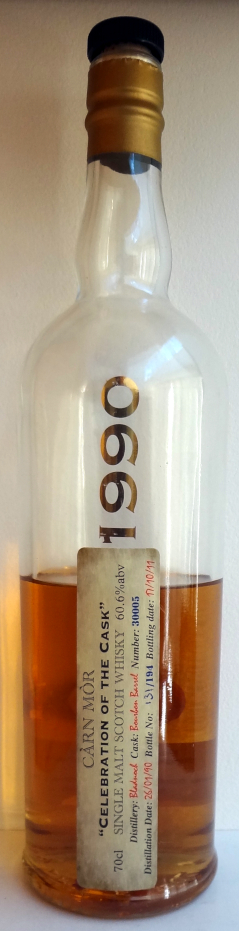 Nose: "very, very industrial," says Bishlouk, with solvents (Bishlouk) and hazelnut oil (Gaija). red71 agrees it smells quite chemical, with a tin of paint and decking stain, strawberry bubble gum (Gaija and me), artificial flavouring (STL). Gaija finds it a Glenisla touch, while red71 notes liquorice roots. For my part, it is limoncello-infused fudge. Water adds wine gums to the mix.
Mouth: stripping (Bishlouk), teeming with violet sweets (red71), specifically the chewy Agent de change. This whisky clings to the mouth. Water brings spring over the party, with jasmine (Gaija) and sangria.
Finish: bitterness and lots of nutmeg. Button mushrooms (Gaija), turpentine (Gaija), limestone in a Bladnoch way (Gaija again, who turns more and more lyrical -- the alcohol going to his head, certainly), dry white wine, Sancerre style (Gaija), saké (Gaija).
Comments: Gaija suggest it could be a Mortlach, before claiming it is a Bladnoch, or maybe a Springbank. Bishlouk doubts the Springbank hypothesis very much. "This cannot be a Bladnoch at any rate" (red71).
Bladnoch 20yo 1990/2011 (60.6%, The Scottish Liqueur Centre for Càrn Mòr Celebration of the Cask, Bourbon Barrel, C#30005, 194b, b#131) 8/10
Full notes here.
Needless to say Gaija is ecstatic to have recognised his favourite distillery.
STL observes that Gaija specialises in early-1990s Bladnoch: he brought one to this year's Burns' Night. A narrow niche indeed.
I underline that Gaija specialises in Bladnoch distilled on 26/01/1990, an even narrower niche.
Dram #5
 Nose: tapenade, loud and clear, capers, rancio, and lots of earth, of both the dry and the greasy kinds. It starts out with a whiff of sulphur (Gaija), ash, and clay floors. The nose evolves a lot, shooting in all directions, covering all bases (Bishlouk). Gaija has chicken broth, I have ground ginger. Further nosing reveals cork shavings and lots of earth.
Mouth: subtle cork indeed, clay floor, and an explosion of spicy mandarins (a generous dusting of cinnamon powder). Gaija finds it oily, with peanuts and cashews. It is voluptuous, coating, full of flavours, but they are caught up by a slightly-ill-integrated alcohol (Bishlouk).
Finish: a faint note of liqueur (red71), resin (STL), a drop of cough syrup. Water makes the mouth more balanced, but it weakens the nose a bit (Bishlouk).
Comments: Bishlouk likes this a lot; he calls it complex and complete. As for myself, well, it is the masterpiece I know it to be.
Linkwood 26yo 1975/2002 (56.1%, OB Rare Malts Selection, b#5373) 9/10
Full notes here.
Excellent session. Well pleased with how well the drams were received. Most, I liked more today than previously. Poor JS is the opposite. Nothing tasted as good for her.

18 May 2022
18/05/2022 St. Magdalene
 St. Magdalene 26yo 1982/2009 (59.1%, Douglas Laing for The Whisky Shop Glenkeir Treasures Cask Strength Selection, 144b): nose: a superb mix of dried herbs and heady flowery bushes. It is hawthorn, honeysuckle, oregano and tarragon, in no particular order. The herbs are quickly overtaken by the fragrant flowers, however, reduced to macerating twigs in a posh grappa. There are squashed bunches of green grapes that give the nose a sweet air, and then the herbs come back in full force -- thyme, rosemary, marjoram and citrus foliage. When looking hard for the minerality that St Magdalene often displays, one may detect a whisper of flint, very subtle. More fruit comes up, straight after that; prunes, macerated plums, and even peaches in their velvety skin. Strangely enough, the second nose smells like a cheap blend, for a second. Leafy tones then takes over to introduce peachy marzipan. A couple of drops of water turn the nose into a bed of yellow flowers, not particularly fragrant, but unmistakable. Maybe, just maybe, there is now a hint of sulphur, before dark-grape juice appears. Mouth: it is assertive from the get-go, full of caramelised peaches, dried herbs (thyme and marjoram), spices, and also a tiny smoke. The spices in question are chilli powder, ground cloves, ground cinnamon, barely noticeable, ginger powder, and smoked paprika. It has more flint on the tongue than the nose promised, yet it is coated in juicy peach flesh. The second sip seems fresher and fruitier; it stays spicy, less hot. This now has hot metal and strong lemon thyme. Water tames it entirely: it is now a charming, juicy, fruity number with an added drop of manuka honey. Finish: bold, warming, impressive and, ultimately, comforting. Here is a tart made with underripe plums, sprinkled with oregano, and served on slate (or flint) plates. It is pretty spicy in the finish too, even if it is not off the scale. Ginger powder, ground cardamom, sawn hazel wood. The flowery notes from the nose are nowhere to be found, and the fruit, if present, is very much stone fruit (peach, plum) -- and the stone comes out louder than the flesh. The second sip changes that: it puts some juicy fruit flesh back onto the stones and shakes the flowery bushes, allowing a few honeysuckle and magnolia petals to fall from the tree. It has got mint lozenges too, by now, which harks back to the newfound freshness of the palate. The death brings a herbal bitterness to mind (rosemary, grape-pip oil), and leaves the mouth dry, as if one had been sucking on rocks. The effect of the serious ABV, certainly. Water confirms the mint lozenges. Apple mint rocks up, sugar in copious doses (amazingly, it does not turn sickly) and lashes of fruit that are now more subdued. There is a ghostly charcoal-y or sulphur-y presence, slightly-burnt marmalade, though, even if paying close attention, one could easily miss it, or not identify it (hence my use of the word 'ghostly'). This is amazing. 9/10