 Ardmore 1992/2010 (49.4%, Malts of Scotland, Bourbon Barrel, C#5014, 185b, b#169): nose: the first whiff announces another rustic-as-fook dram, with a fireplace in a mountaineering bothy, twigs ready to be burnt, dry clay floors, and, generally speaking, a welcoming, dry place, when it is cold and damp outside. It is far from all, however, and, underneath all that, careful nosing will pick up candied pineapple cubes and crystallised strawberries, mixed with borderline-charred hazel wood. The earthy note (remember clay floors?) becomes richer, closer to potting soil, and we also find a pinch of soot. Still, strawberries make that fresher and livelier, and they come across as chewy too. In fact, they may be strawberry chewing gum, at this point. Baking frangipane makes a late entrance, sweet, chewy, and almond-y -- or, at least, it promises to be. The second nose sees a few of the same fruits (strawberry, pineapple) fall into a bucket of dry twigs and coal. The deeper one noses, the more fruit and the less coal, merely a sprinkle of charcoal gratings on a fruity yoghurt. Much later on, we have dried sausage (of the light kind, so partly dried only), and light smoke re-appears too. Mouth: almond-bitter in the attack, the palate slowly opens up on the tongue to prolong the beauty of the nose: warm hazel wood, a pinch of soot on a dry clay floor, and swirls of fruity smoke, namely strawberries and candied pineapple cubes. The smoke is bold, softly acrid, and that is very comforting indeed. The fruit in it makes me think of those scents vapers put in their Death sticks, yet it is nowhere near as invading or unpleasant as, say, their strawberry muffin -- oh! no, quite the opposite: here, it is all subtle, balanced, and very much an asset that elevates the already-excellent palate. The second sip raises the power and the bitterness, with heated dried-garlic shavings, and hot almond milk to complement the strawberry, which is now smashed into a creamy, yoghurt-like pulp. Yum! Finish: how I enjoy those naturally-reasonable ABVs! 40%-50% of undiluted joy is my sweet spot; this is no exception. It pets the senses, rather than assaulting them. It feels much less smoky, here, and fruitier instead. More strawberries, stewed, this time, candied pineapple cubes, and dried raspberry slices, rehydrated, and sprinkled with an interesting blend of confectionary sugar and soot. A gentle touch of dusty old wood lingers, as discreet as possible. Here too, subsequent sips turn fruitier, teeming with strawberry. The mouth ends up coated with an oily film, and retro-nasal olfaction reveals a chlorinated-water note, swimming-pool style. We also spot asafoetida, which is a step further than the dried garlic from the palate, perhaps, though firmly in the same direction. This is excellent. On another day, I may score it higher. 8/10
31 July 2023
31/07/2023 Ardmore

28 July 2023
28/07/2023 Linkwood
 Linkwood (100° Proof, Gordon & MacPhail, b. ca. late 1970s): still no age statement, but 100° Proof, this time. Nose: and what difference 30° Proof make, eh? This is immediately warmer and punchier than the other miniatures we had recently, with heated cast-iron boilers, healthy lichen that takes advantage of a higher temperature to grow boldly, stacks of dust-dry pine-tree logs, and dried peach skins. Breathing time brings a timid fruitiness -- so timid that I am struggling to identify it. There is also steamed broccoli. The second nose has a fleeting, almost-perfume-y note of magnolia, and metal filings. Water brings out hot candlewax, unripe apricot, greengage, and heated Brighton Rock. Here is a note I have never used before! And I reckon I have not had Brighton Rock in forty years either, so my memory of it is perhaps incorrect, yet that is what I am reminded of. Sadly, Brighton Rockstar WhiskyLovingPianist is not here to confirm. Mouth: it is punchy alright, though a silky texture soon makes one lose one's bearings. Unexpected. Nevertheless, out of that confusion, cast iron and bitter lichen rise, mostly smothering a tentative fruity side. At this point, it is probably unripe apricot, yet it is so faint it is hard to be certain. The second sip grows bitterer, firmly focused on hot, coarse metal, and crushed bay leaves. It drowns with water, surprisingly. Even the tiny amount I added makes this little more than flavoured water. Menthol and unripe nectarines, perhaps. The texture remains as pleasantly silky. Finish: big, bold, we find grey-ink-covered cast iron, military dark-green paint, dry-brushed on boiler plates, and the most minute drop of peach juice sprayed onto it. It does not evolve dramatically upon repeated sipping, yet it turns a tad dustier. A minute or so after swallowing, gravel appears. Water opens up the finish, remarkably releasing peach and nectarine slices, a lick of sugar glazing on a sage doughnut, and shiny metal that comes much closer to the steel of a blade, or the tin of a can than the earlier cast iron. This is very good, if not overly complex. It is a bit closed neat, and very different with water. 8/10
 |
| And if you think it looks like the Mortlach from the other day, it is because it does. Gordon & MacPhail also used the same eagle for Talisker bottlings |
25 July 2023
25/07/2023 Mortlach
 Mortlach (70° Proof, Gordon & MacPhail, b. ca. late 1970s): nose: in one word: rustic! Piles of lichen-covered branches, cut and stacked in preparation for the winter, wood stoves, antique hot water bottles made of copper, musty dunnage warehouses, and Verdigris all feature, at one point or another. Moss-covered metal and billows of grey smoke too. Here is an old-school nose, if we ever sniffed one! Centuries-old gardening tools that were once used to work a sandy soil, saxifrage and lemon thyme growing on a lime-rich ground, and tangerine turning blue with mould. The second nose has smoked lime leaves, cured limes, and the filling for a lime meringue pie -- which is safe to assume is lime meringue. Later on, delicate nail varnish has a peek too, alongside fancy, scented-crayon shavings and subtle erasers. Mouth: one would struggle to identify the Beast of Dufftown in this. Hail Mortlach in Bourbon casks! The rustic character of the nose takes a back seat, and lets citrus roar. Pomelo, pink grapefruit, clementine, peels included, which gives a soft bitterness, and a mildly-rubbery texture. Scratching the surface, one may spot liquorice allsorts, via retro-nasal olfaction, yet this is mostly a fruity affair. The second sip has flat pomelo lemonade (did we call it pomelonade, in the past?), and turns sweeter with every passing second. Flat pomelo lemonade, now enhanced with Galia-melon juice. It gives a strong, light-green impression, fruity, bitter, acidic. It is also faintly sooty, in the long run. Finish: at an ideal strength, this has the same fruity tones as the palate, perhaps with more-pronounced rubber. It is by no means overly rubbery, yet it certainly has a chewy bitterness to counterbalance the fruit. And chewy it is! Chewy, coating, quite like citrus peel. In the back, we see combava leaves, waxy, chewy, and citrus-flavoured. Behind the fruity acidity, the second gulp somehow gives a whisper of white smoke that would be mildly acrid, it it was less subtle. Smoked Galia melon blends with pomelonade again, with just a pinch of soot to keep things interesting. This is outstanding. Perhaps I am overly generous, today, but I will score it 9/10
24 July 2023
24/07/2023 Old Pulteney
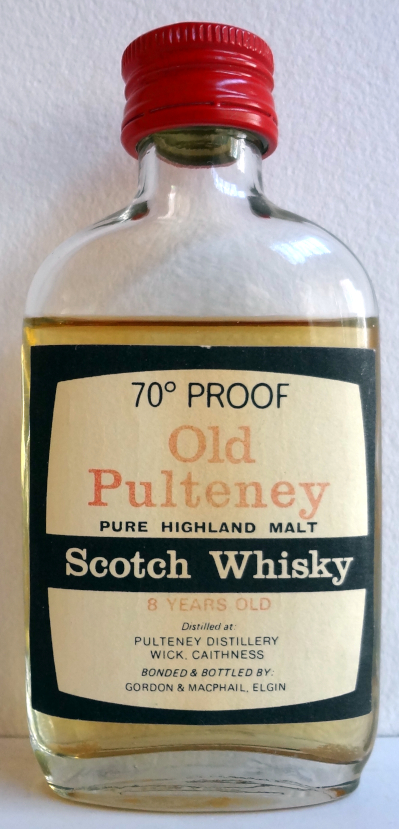 Old Pulteney 8yo (70° Proof, Gordon & MacPhail, b. ca. late 1970s): you can tell Gordon & MacPhail were bottling these semi officially (in the since explicitly-named Distillery Labels collection): no-one else calls it Old Pulteney, which is a trademark. Instead, others point to a whisky distilled at Pulteney Distillery, a mention that appears in smaller characters on this very label too. Nose: phwoar! From the first sniff, it is easy to see why Pulteney got "The Maritime Malt" nickname. Sure, we have cut apples, yet what dominate are harbour scents: sea breeze, sea spray, diesel-engine fumes, rusty metal, chipped paint, eroded by salty, humid air... In fact, the impression of corroded metal is strong, in this one, bending and twisting to blend with red-apple peels, smoked, then dunked into an old paint tin. The second nose insists on corroded, borderline-rusty metal, and old paint tins, whilst retaining the sea air. It adds mentholated shaving foam and ground lemon pips for originality. Mouth: heavy-metal fans, rejoice! The story of iron continues, with bitter steel, metal hoardings, corroded corrugated steel sheets, and drill bits, all over a milky texture. It is not all metallic bitterness, fortunately; we also have apple compote, here, apple peels, home to growing lichen, fruit-tree wood smoke, and sanding dust. The second sip is as bitter at the start, then it relaxes a bit, morphing into the peel of citrus that has grown by the shoreline, fruity, salty, and a little more bitter than it is acidic. Maybe we have crushed effervescent tablet with a citrus taste? Imagine lemon-flavoured Alka-Seltzer, and lime leaves. Finish: bold and lively, the finish has a kick! No power lost to the angels, here, despite roughly half a centilitre's evaporation, over the decades. Roasted apple slices, served on a heated steel or pewter plate, the velvet shrine in which that pewter plate is normally displayed, a whisper of smoke (though what the source is is less clear), but very little of the coastal elements, at this point. The second sip has dried citrus peel (pomelo), lemon thyme, and crushed Kaffir lime leaves. It is remotely salty, though that is overshadowed by the citrus. Belatedly, a drop of pouring custard appears. Imagine a tequila shot for which salt has all but run out. The death has remnants of the leafy bitterness, and spouts out some of the diesel fumes from earlier. This is excellent. 8/10
21 July 2023
21/07/2023 Belgian National Day
Patriotism grips me so much I will sample something Scottish, today. And while we are having eight-year-olds bottled at 70° Proof in flat minis...
 Glenrothes-Glenlivet 8yo (70 Proof, Gordon & MacPhail, b. ca. late 1970s): nose: oufti! (ooft!) Sherried, yes, yet far from the recent Glenrothes expressions, which I find overly buttery, to the point of being sickly. Here, it is all precious woods and fortified wines. Pedro Ximénez, tawny Port, mahogany, teak, and polished dashboards, rich, deep, and dignified. A minute of breathing pumps rancio into it, the dusty clay floor of a dunnage warehouse, and a heap of lichen-covered, cut branches (apple tree), drying before it is used as heating fuel. Later on, a fruity note tickles the sinuses: myrtle boiled sweets, crystallised orange segments, lemon or lime Sugus, candied angelica. Finally, boiled red-cabbage leaves come into focus, then disappear almost as quickly as they arrived. The second nose clearly has coffee, very-distant burnt tyres (must be those protests in France), and gradually moves towards chocolate (of the dark-ish kind, much to my delight). Looking hard, we find a drop of washing-up liquid, hardly worth mentioning. Then, boiled mud, or clay, and fruit-scented air-freshener rock up, faintly mentholated too. As one tilts the glass, roasted apples tumble out of it. Mouth: fresh, fruity, acidic. It appears sweet, for a fraction of a second, but it turns citric in no time, shooting pink grapefruit, clementine and pomelo in all directions. There is a soft bitterness too, almost rubbery, and the texture is chewy and a half, reminiscent of liquorice boot laces, or toasted, then stewed star anise. The second sip, without being smoky has more of a chimney-sweep feel, with sooty metal brushes and coal dust. Those are easily matched by a bold fruitiness, however; cut apples and plums, soaked in Sherry until they are soft. What is most remarkable is how punchy this is! Bottled at the legal minimum of 70° Proof more than forty years ago, with a dwindling fill level, and yet... Over time, wood lacquer settles in, a bit solvent-like, yet elegant. Finish: mellow, not weak, here are chewy liquorice, cured citrus (peel and all), a big chunk of candied angelica, and chewy sweets, Sugus or Starburst style. The second sip is sweeter and fruitier, and the cut apples and plums from the palate make an assertive comeback, emboldened by all that fortified wine they have been soaking in. We also find nut oil, coating and heart warming. Elderberry cordial, Frangelico, candied angelica, frangipane, Grand Marnier-infused custard all leave a softly-bitter dryness in the mouth that makes this dram rather moreish. Wow! 8/10
 |
Ô Belgique, ô mère, chérie A toi nos cœurs, à toi nos bras! A nous tes frites! |