25 September 2020

24/09/2020 Affordable whiskies

JS, red71, STL and Bishlouk gather online to try some drams from JS's collection and mine.

I have already taken lengthy notes for all but one, so tonight is a social affair. I do write down a few comments, but very little. For the record only.

Naturally, they try everything blind; I know what all the drams are.


Dram #1 (JS)

Nose: fresh and minty, with pears and yellow flowers.

Mouth: lovely texture, pear drops and minty lozenges.

Finish: custard and mint again, biscuit, green-hazelnut paste, but without the bitterness I would normally associate with that.

Comment: the others seem to enjoy it as much as I do. STL guesses Inchmurrin, while Bishlouk ventures an ancient young Littlemill.

Glenmorangie Artisan Cask (46%, OB, White Oak First Fill Hogsheads, b.2005, L5 244 15:57 4ML) 8/10

Full notes here.


Dram #2 (JS)

Nose: solvents, according to red71 and Bishlouk. The former likes that, the latter less. Solvent dissipates with water, they tell us.

Mouth: astringent and strong. With the difference in ABV, it is hardly surprising!

Finish: they find it drying, not desiccating, and woody, which matches my own impression.

Comment: this did not fare too well, tonight. Tough audience? Sequencing mistake? Who can tell?

64.32 10yo 2001/2011 Nutty delights (59.1%, SMWS Society Single Cask, 1st Fill ex-Bourbon Barrel, 245b) 8/10

Full notes here.


Dram #3 (tOMoH)

Nose: apple peel (STL), lichen, verdigris. In fact, it is orchard fruit, growing mould on the skin.

Mouth: chewy as fook, it has more lichen and apple peel.

FInish: strong alcohol presence, with Bishlouk very close to calling a nurse to revive him. The others do not agree and find the alcohol rather well integrated.

Comment: lost of guesses, none right. In no particular order: Rosebank, Glen Ord, a Speysider finished in Banyuls casks. I laugh my head off. Internally. I have to admit that this is not affordable at all, though.

Garnheath 27yo 1972/2000 (59.4%, Signatory Vintage Silent Stills, C#386516, 190b, b#182, 00/81) 8/10

No detailed notes for that one yet. They will come.


STL: "It reminds me of Glenfiddich 21yo. Except that I don't like Glenfiddich."

tOMoH: "Is that because of the triangular bottle?"


Dram #4 (tOMoH)

Nose: mud and peat, as well as cow dung, drying in the fields. The others detect no peat at all. Bishlouk finds it "very young," and immediately puts out a disclaimer that he is very bad at recognising new makes. Out of courtesy, we do not point out to him that he is very bad at more than that.

Mouth: Bishlouk is finally struck by light peat.

Finish: elegant, with more refined peat.

Comment: lots of guesses, none remotely close.

Gerston (46%, The Lost Distillery Company, Series #3, B#1.I, b#0399, L13/9035, b.2013) 7/10

Full notes here.


Dram #5 (tOMoH)
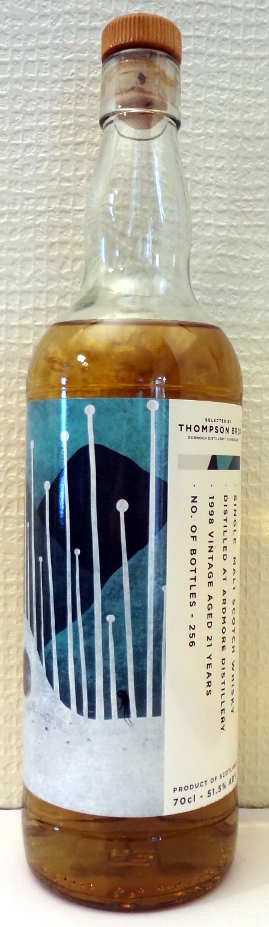
Nose: minty and fresh too, this one has squashed raspberry, this time, and a pinch of ginger powder.

Mouth: fresh, sweet, and... silt-y. Bishlouk has sweet vanilla.

Finish: juicy peat, intertwined with faded leather, squashed raspberry and Chinese gooseberry.

Comment: third time I have this, and it was a different experience each time. It jumped out of the glass at nosing time, changed a lot, then became tamer, more polished and more "usual," say the others. I do not fully agree, but it does change.

Ardmore 21yo 1998/2019 (51.5%, Thompson Bros., Refill Hogshead, 256b) 8/10

Full notes here.


Another fine night of fun. I did not even take pictures. :-/

21 September 2020

20/09/2020 Deanston

Only one dram again.


Deanston 35yo 1977/2012 (40.4%, The Whisky Agency & The Nectar, 253b): nose: meow! Purr! Phwoar! Yellow fruit and spring flowers, with, in no particular order, honeysuckle, lilac, lily of the valley, plums, nectarines, white peaches, ripe bananas, melting conference pears and apricot jams. Next to that, cotton candy gives a sweetness that is most appealing. The fresh fruit soon morphs into cooked fruits of all sorts; strawberry and plum jams, yet also apple compote, squashed baked pears, and pineapple-y custard. Timid blueberry coulis shows up at the back of the sinuses too, then a citric side becomes evident with sweet-grapefruit segment (skin removed), kumquat and calamansi. Further back still, and very subtle, a drop of mercurochrome elevates this to more than a "mere" fruit bomb. Mouth: at this magical, naturally-low strength, it tickles the taste buds without distracting from the flowers, nor does it seem weak -- simply perfect for tOMoH. Strawberry jam is the first to appear, softly acidic, soon followed by pineapple slices and cut nectarines. In fact, it is teeming with yellow and white fruits; white peaches, plums, banana slices, even gentle grapefruit, dunked in custard. Custard! Yes, that is the texture: lukewarm custard, liquid, but almost oily, in terms of viscosity. Finish: creamy and fruity again, it has something more, this time; something earthy or root-y. A pinch of soil, a sack of earthy potatoes, straight from the vegetable garden, perhaps leeks. Make no mistake, though: if it permeates even the nose, once the first sip is swallowed, that earthiness is shy and subdued. The most noticeable is that creamy fruitiness that carries peaches, plums, pineapple, nectarine, pear, banana, grapefruit-y custard and a spoonful of strawberry jam. Amazing Deanston. My favourite expression of that distillery, to-date. 9/10 (Thanks for the dram, JS)

14 September 2020

13/09/2020 Trip to Ayrshire

During the no-longer-so-recent closed distilleries tasting  the presenter observed that, if the whisky is officially bottled as Ladyburn, independent bottlers call it Rare Ayrshire.

Indeed, some do: Signatory, The Whisky Talker and The Ultimate do call it Rare Ayrshire, with the latter two probably using Signatory's stock anyway. Duncan Taylor and Gordon & MacPhail have both bottled Ladyburn under the name Ayrshire (not Rare), whilst James MacArthur has done a limited run of miniatures under the official name; it was but a re-bottling of an official bottling.

That leaves but Cadenhead and Blackadder, who both bottled Ladyburn under that name. Cadenhead probably did so before William Grant became so protective of their brands, and Blackadder tend not to give many fucks about what they are allowed or not allowed to do.


The above is so well known, these days, that (Rare) Ayrshire and Ladyburn are used almost interchangeably, outside of the legal mine field that is the label on the bottle. Case in point: as I was browsing the latest auction on the evening of 8 September, it was not even a surprise to see several lots advertised as Ladyburn-Ayrshire, alongside a brief description of the long-lost set of stills within the grain plant.

Being a ghost hunter, Ladyburn is of course a distillery I am fond of. One of the aforementioned lots had a reasonable highest bid. It was a Malts of Scotland bottling, which was interesting to me: one I have not yet tried and that is not on my shelves. I put the lowish bid down to the bottling not being well known (I did not know it, after all; I could not be the only one). I bid on it without thinking too much.

It took me several minutes to realise my mistake.

Looking a little closer, it turns out it was a 1991 distillation, bottled 2020. Ladyburn closed in 1975. Also, the cask number was on five digits. It did not add up. Looking even closer, the label read 'Single Grain'. The penny dropped.


I suddenly remembered that independent bottlers, Signatory perhaps leading the pack, had started bottling Girvan under the name Ayrshire (not Rare). Maybe William Grant asked them not to use the name Girvan any longer, now that they bottle it officially too, I do not know.

The result is that, on the market, one can now find:

  1. Ladyburn: officially-bottled Ladyburn single malt
  2. Ladyburn: officially-bottled blended malt that may contain Ladyburn single malt
  3. Ladyburn: independently-bottled Ladyburn single malt
  4. Rare Ayrshire: independently-bottled Ladyburn single malt
  5. Ayrshire: independently-bottled Ladyburn single malt
  6. Girvan: officially-bottled Girvan single grain
  7. Girvan: independently-bottled Girvan single grain
  8. Ayrshire: independently-bottled Girvan single grain
  9. Ailsa Bay: officially-bottled Ailsa Bay single Malt
  10. Images of Ayrshire: independently-bottled Ailsa Bay single malt

The lot I bid on, I thought was #5, but it was instead #8.


I immediately contacted the auction house and pointed out the confusion generated by their labelling a Girvan Ladyburn-Ayrshire. I expected nothing. After all, many auction houses tend to go to great lengths to shift the responsibility towards the bidder (what you see is what you bid on, and your bid is legally binding).

The auction ended and, of course, my bid was the highest. The previous high bidder was probably ecstatic that another absent-minded bidder saved them buying a 28yo grain whisky for the price of a 30yo Caol Ila. Especially seeing as said grain was still widely available in shops for a third of the winning bid.

I put it down to experience. Bitter experience.


Much to my relief (and surprise, let me be honest), the auction house took responsibility for the mistake the following day and cancelled the sale. For that, many thanks; it was a very professional gesture.


Clearly, I should have paid more attention and done more research. The thrill of the last-minute auction got the better of me. I was lucky, in the end: I noticed when something could still be done about the situation, and the auction house was willing to do that something to correct the situation.

With a name being used to designate so many different things, confusion is almost inevitable, even amongst the professionals, as illustrated by the above screen shot and my little tale. Vigilance is needed. Others may not take responsibility for the confusion and it may result in an expensive bottle of grain whisky indeed.


To celebrate, let us have the real thing (#3 above).


Ladyburn 20yo 1966/1987 (45.7%, Cadenhead): nose: it is bold, it is assertive, and it is welcoming. Waxy apple peel, pencil erasers, a sprinkle of dust, and old rags, crusty with dried beeswax. The nose becomes more floral shortly thereafter, with buttercups and daffodils, then geranium and tagetes (marigolds), and even more herbal tones of fresh sage and saxifrage foliage. The carousel of alternating flowers and waxes is nothing short of spectacular, really. Vine leaves, ripe plums and a drop of gentle ink complete the first nose. The plums become riper and darker over time, bordering on soaked prunes, eventually. The nose also carries something else, something discreet that may even be plasticine, rather than modelling clay or wax. Mouth: miraculously, the mouth is similar. It has plums, prunes, waxy apple peel and sweet flower nectar (daffodils, buttercups). The texture is thick and oily (extra-virgin olive oil), and there is a faint bitterness akin to when one licks a pencil eraser. The crusty rags are still there, the wax on them has lost nothing of its fragrance. The second sip sees a nutty side too, perhaps sweetened macadamia-nut paste, or cashew-nut-paste sweets (kaju katli), as well as dried fruits (dried apricots, dried figs). Every sip is chewier than the previous. The alcohol is perfectly integrated, yet maintains enough power to keep one engaged. Finish: a drizzle of milk-chocolate coulis punctuates the plums, daffodils and pencil erasers from previously. We also have waxy plants: geranium foliage, laurel leaves, schefflera leaves, and beeswax, though less of that last one than on the tongue. The dried fruits (apricots, figs, sultanas) are in the finish too, and they are well chewy, which makes for a lasting impression -- a good one. What a superlative whisky! 9/10 (Thanks for the dram, JS)

07 September 2020

05/09/2020 Three decades of Coleburn

Coleburn 17yo d.1965 (40%, Gordon & MacPhail Connoisseurs Choice imported by Co. Import for Giacinto Nicolai of the Club delle fattorie, Series 27, 120b): nose: old cola, peppered maple syrup, toasted wood and toffee. The first sniff has subtle burnt wood and burnt cake crust as well, though it only lasts for seconds. Some vanilla aromas then take centre stage, with butterscotch and mocha-flavoured butter cream and tiramisù in the making (that would be biscuits, soaking in a coffee-and-amaretto blend). Distant dried thyme leaves, hawthorn appear, then a soft, sulphury side -- brimstone, cordite, matchbox striker. Prunes and black olives are next, followed by wood lacquer and the timid come-back of the initial burnt-wood note. Mouth: wood lacquer interweaves with nutty prunes, velvety and sweet, before cured ginger shavings join the party. Almond skins, whatever amaretto would taste like if it were not so sickly sweet... This is mildly bitter indeed. The texture is rather thin, with plum juice and the bitterness of the plum stone (or it is still those almonds?) Finish: crushed roasted almonds, almond skins, prunes and dusty toasted staves. It is a slightly-overly-baked almond cake, served with a dollop of unctuous vanilla custard and, perhaps, chopped fresh plums. The bitterness remains, though one would have to be very sensitive to find it bothersome. It has little of the sulphur, here, but the roasted notes become more pronounced with each sip; burnt cake, coffee grounds and even rubber. The soot I detected the first time has been replaced by earthy and toasted flavours. All in all, a very good and interesting dram. 8/10


Coleburn d.1972 (40%, Gordon & MacPhail Connoisseurs Choice, b. late 1980s): there were at least a handful of these expressions with the first map label, bottled between 1987 and 1996. Considering this one has no bottling code, it is very likely one of the very first ones -- my bet is 1987. Nose: OME, with ground white pepper, dust and straw, though little vinegar, in this one. Let us give it some time... Dry brine (as in: the residue in a jar that used to contain brine), sawdust and ginger peel. The white pepper grows in intensity too. Suddenly, ink, blood-stained bandages and Iso-Betadine shoot out of the glass, as welcome as they are unexpected. Pretty quickly, the pepper is back, on top of hay bales and a wheelbarrow of coumarin. Mouth: the pepper is present on the palate too, even if it is merely a supporting act for the new star: salt. Foccacia, with rock salt, rosemary and all, capers, seawater, (from the Dead Sea!), halibut -- yes, it is a bit kipper-y. The second sip is less outrageously salty; it has mulch, a hay-and-straw paste, sprinkled with lemon juice and white pepper. Cedar-wood sheets and an undeniable tannicity are easy to spot too. Finish: huge, for the modest ABV, it still benefits from an unsacrificed salary (that only makes sense if you understand the etymology of the word 'salary'. If you do not, look it up!) with rock salt, sea rocks, seashells, salt-crusted chicken, salt meadows, capers again, red-leaf-lettuce (chioggia) seasoned with too much salt, hay, then lint and minty gauze, as an afterthought. Salt invades every sip, the second of which brings raw potato slices, salted at will -- yes, crisps, before they are baked. The whole leaves the mouth dryish and this taster craving water! The final sip has a spoonful of dusty custard, yet the baker must have mistaken the salt for the sugar. An interesting ride, although this cannot have done too much to boost the Coleburn name, I would imagine. 7/10


Coleburn 20yo 1980/2001 (50%, Douglas Laing The Old Malt Cask 50°, Sherry Cask, 648b): nose: immediately, the sherry speaks, and I firmly believe it was an Oloroso cask, as this nose has an earthy side to it. That said, it also shows tinned lychee, so who knows? It might have been a Fino. Fragrant jasmine, lily of the valley, lilac and more fruit -- tropical again: dragon fruit, guava, white peach join the lychee. The nose also lets through whiffs of lichen and cork, both dry to the point of crumbling and mouldy. At last, that smell of a drinks cabinet as one opens it comes up (Chardonnay, brandy, white Port). Once that dissipates, rancio picks up and does not let go, supported by roasted raisins. Mouth: the mouth is more wine-y, with notes of juicy sherry, a little earthy too, maybe with a pinch of coffee grounds. Lychee is behind the scene, letting its presence be known in a subtle fashion. Brown banana skins, burnt toast, roasted peanuts, Brazil-nut oil and, yes: coffee grounds are absolutely present, overpowering the lychee in the medium run, unfortunately. The second sip brings raisin liqueur (would it be PX sherry, after all?) and wood shavings -- from precious wood; perhaps mahogany. Finish: wow! The finish is much more drying than I expected, with a mix of coffee grounds and scorched earth, aniseed, burnt toast and gunpowder. Not much fruit left, at this stage, and if there is, it is burnt fruit stones (prunes) rather than juicy flesh. The second sip welcomes a shy drop of pressed grapes, underlining the sherry influence again. There might be dried dates and figs, but behind the earth, they are pretty much undetectable. Good and seemingly more complex than the previous two drams. Good sherry maturation, this. 8/10 (Thanks for the sample, EG)

04 September 2020

03/09/2020 Glenmorangie Madeira

Only one dram, today. I have found it hard to muster up the motivation to do more, lately.


If my memory is correct, in the late 1990s, Glenmorangie released several whiskies that had been matured in "unusual" casks as an experiment. They worked well enough to integrate the core range in the early-to-mid 2000s. I believe what we are looking at today is the first incarnation of this Madeira Finish as a regular expression, rather than something more limited. The follow-up second incarnation, with the green-striped label, I thought was the best of its generation, which included Burgundy, Sherry and the popular Port finishes. This first one with the green livery, I cannot recall trying before.


Glenmorangie Madeira Wood Finish (43%, OB, 8327, b. ca 2000): nose: syrupy fortified wine, yet not a dark one -- I am thinking tawny Port or Fino Sherry, though probably sweeter than the latter. Sultanas, dried figs, dried apricots, white peach slices, nectarines. Then, out of nowhere, fresh, sappy notes appear; not quite pine drops, but it does smell as if someone vapourised mint toothpaste onto the fruits. Or is it fresh rosemary sprigs, perhaps? A couple of sniffs later, the toothpaste/rosemary goes away, replaced with walnut oil and raspberry vinegar. This nose is as seductive as it is interesting. A faint whiff of straw bales under a drizzle that just broke out, geranium, and then it magically goes back to walnut oil and syrupy wine. Mouth: good attack, despite the reduction (but of course, it is only my first dram), it has the dried fruits of the nose (figs, apricots and sultanas, re-hydrated, this time) and cracked green pepper on fresher fruits, such as white peaches and nectarines. The gums perceive a gentle woodiness that in no way detracts from the enjoyment; merely a pinch of ground galangal, sumac and ground cloves. The texture is that of a thick liqueurs, almost honey-like, and it is made almost sparkly by a distant touch f peppermint. Lovely. Finish: cigar leaves and fortified wine on steroids, sweet, robust, elegantly woody, voluptuous, warming and comforting. A notch of vanilla via retronasal olfaction too; toffee, butterscotch, sticky toffee pudding, and the subtle, drying character of bay leaves in a sauce. This is unashamedly moreish and, if it probably never did and never will change  anyone's life, for the 45 EUR such a bottle cost upon release, it seems remarkable value for money. 7/10 (Thanks for the sample, kruuk2)